iGEM 2019 "Degrading Microplastic"
In 2019 I participated in the worlds biggest science contest the "international Genetically Engineered Machine" with the Humbold University team. The project aimed to degrade microplastics in water with the help of microalgae.
One of the issues of the gravest impact on our generation is the environmental pollution. Especially the production of synthetic polymers, like plastic, has increased considerably since the 20th century (Andrady, 2011). Plastic is the most frequent material collected in studies on the surface of the Oceans (Law et al., 2010) and is also observed on the seafloor (Galgani et al., 2000). Even though the exact implication of microplastic to organisms is still unknown, the appearance of microplastic inside a wide variety of marine organisms is significant (Murray & Cowie, 2011).
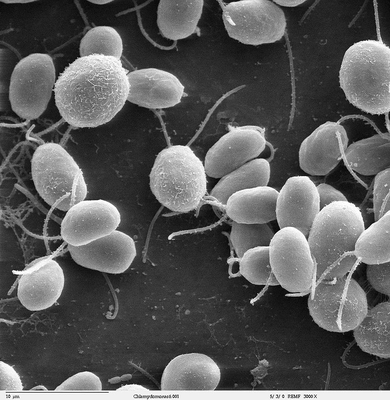
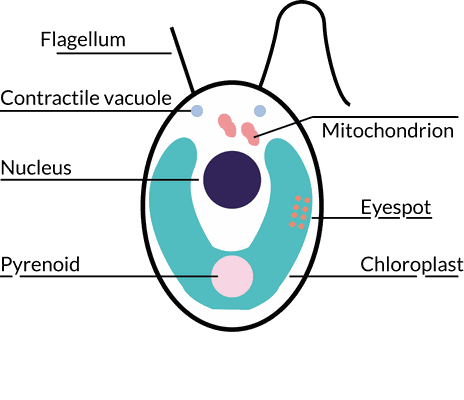
The unicellular green alga C. reinhardtii has an impressive history. It is used since the 1950s as a model organism to not only elucidate the structure of flagellar and basic plant
cellular processes, such as photosynthesis and light perception, but also in research regarding phototaxis, circadian rhythmicity, cell cycle and mating mechanisms (Harris et al., 1989; Harris,
2009). However, C. reinhardtii has not only been used for fundamental research but is also a model for microalgal biotechnology and has become a photosynthetic expression platform to
synthesize recombinant proteins. C. reinhardtii has been engineered to produce biomass for biofuels such as the biodiesel-precursor bisabolene (Wichmann et al., 2018). Chlamydomonas
has also been used in therapeutic applications, having been modified to express an HIV antigen (Barahimipour et al., 2016).
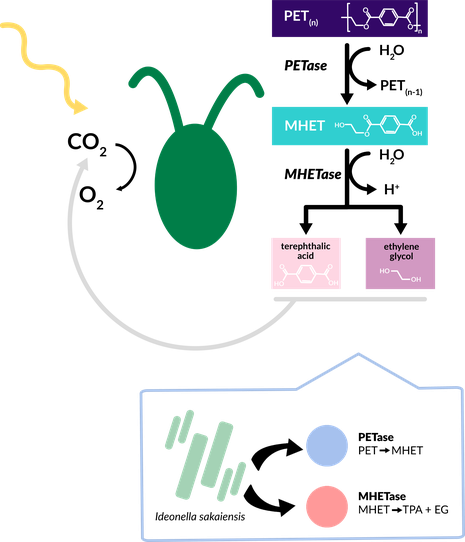
In 2016, the bacterium Ideonella sakaiensis which is able to use polyethylene terephthalate (PET) as a primary carbon and energy source was discovered (Yoshida et al., 2016). This
bacterium secretes two different hydrolases that perform the first two steps in PET degradation (Yoshida et al., 2016). The first hydrolase, PETase, breaks down PET to mono(2-hydroxyethyl)
terephtalic acid (MHET). The second hydrolase, the MHETase, then digests MHET to terephthalic acid (TPA) and ethylene glycole (EG). In 2018, the PETase was characterized and engineered to improve
its performance (Austin et al., 2018). Astonished by the possibility to degrade one of the most commonly used plastics, we were inspired to try to integrate the PETase and MHETase enzymes into
C. reinhardtii in order to illustrate the capabilities of our favorite algae using a toolkit of various genetic parts.
More infos about this project on the iGEM 2019 website link below.